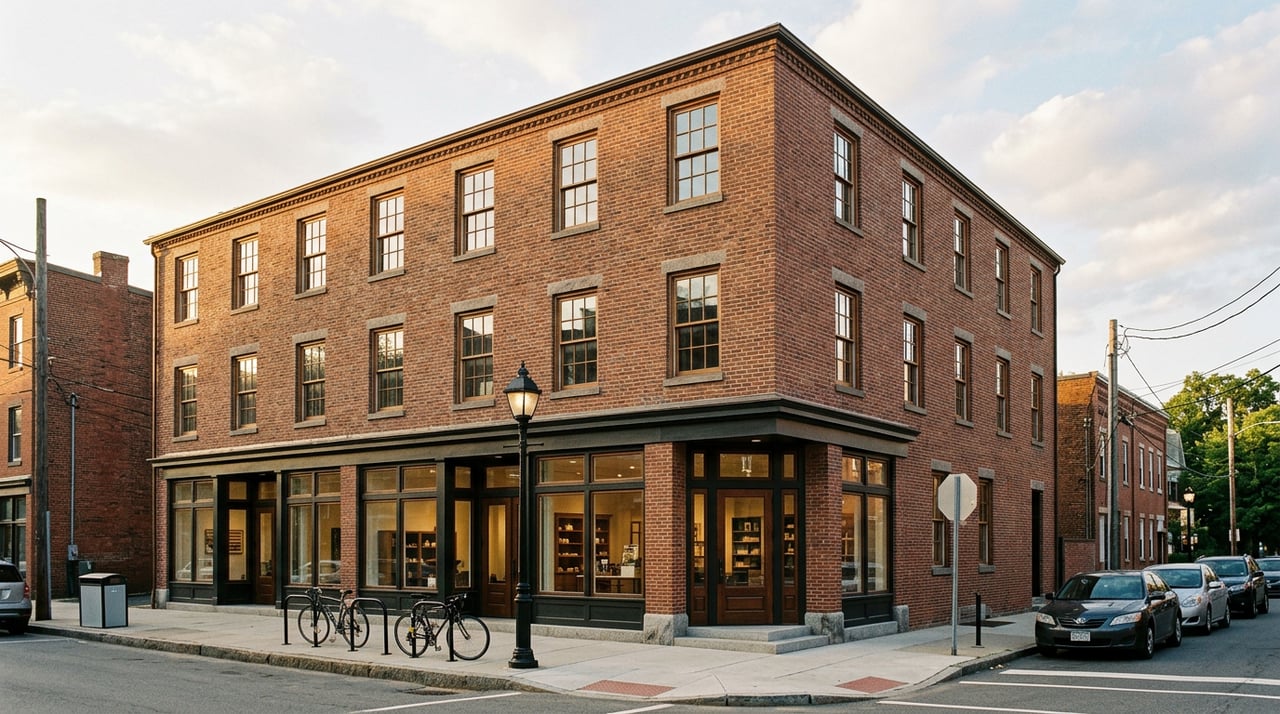
Walk Fillmore between Clay and Pine on any given Saturday this fall and you will pass three kinds of storefronts: one dark theater marquee waiting for its neon to come back on, a handful of construction permits taped to glass where a Michelin-adjacent kitchen is being built out, and a few ordinary vacancies where a home goods store or a jewelry subscription shop used to be. It reads like a single story of neighborhood churn. It is actually two separate stories that happen to be running at the same time, on the same block, and it matters which one you are looking at.
The first story belongs to one buyer. Venture capitalist Neil Mehta, working through a project director named Cody Allen, paid $11 million for the Clay Theater in January 2024, then spent close to $40 million more buying five additional aging buildings on the same three blocks of Fillmore between Clay and Pine streets, roughly $51 million across six properties. The effort has a name, the Upper Fillmore Revitalization Project, and it has been funded in stages: a $100 million raise through an entity called Aegis Reserve Partners LP in January 2024, followed by a $50 million round through Friends of Fillmore LP reported this spring. That second raise is earmarked in part for small business grants and investments on the corridor, including the theater itself.
The second story belongs to everyone else. A food truck graduating to its first permanent address. A burger chain upgrading out of a former Burger King. A taco entrepreneur opening his third location. Those openings have nothing to do with Mehta's assembly. They are just Fillmore doing what commercial streets do, and conflating the two stories is the easiest way to misread what is actually happening here.
The anchor: what's inside the assembly
The centerpiece of Mehta's project is the Clay Theater at 2261 Fillmore, a single-screen cinema that has sat dark since 2020. San Francisco's Historic Preservation Commission unanimously approved its restoration on April 1, 2026, clearing the way for a rehab that keeps the theater's curved ceilings, sloped auditorium floor, and neon marquee while adding a new balcony level, an elevator, and a kitchen. Veteran cinema curator Ted Gerike, previously of Metrograph in New York and founder of the Los Angeles microcinema Now Instant, is running programming. The plan calls for more than 500 screenings a year on 35mm and 4K, plus an all-day cafe in the lobby. At the time of the April approval, Mehta's team told the San Francisco Chronicle the theater could reopen as early as next year, which puts a realistic target somewhere in early 2027 rather than this winter, so treat any specific reopening date you hear this fall as provisional until the marquee is actually lit.
The theater is not the only property inside that same footprint. The corner building at 2001 Fillmore and Pine, formerly home to the beloved Pacific Heights Bar & Grill and later Thai Stick and Noosh, is being rebuilt into Monami, a Korean barbecue restaurant from the chef behind Michelin-starred SSAL on Polk Street. Chef-owner Junsoo Bae has described his ambition for the space in blunt terms, telling the Chronicle he wants it to function as a Korean barbecue version of House of Prime Rib. A few doors down, the four storefronts at 2035 through 2047 Fillmore, formerly Mio and A-Pizza, sold this summer to the same Mehta-backed group, which plans to combine all four into a single restaurant. And the old Starbucks at 2222 Fillmore is set to become a new restaurant from Chef Pim Techamuanvivit, the force behind Kin Khao downtown and Nari at the Kabuki Hotel, though the project is still working through city permitting that will determine what kind of kitchen it can actually run.
Three restaurant projects, one theater, one owner. That is a coordinated bet on a specific stretch of street, not a general trend.
The rest of the strip: ordinary turnover, different owners
Everything else opening on Fillmore this year is unrelated to that bet, and the distinction is worth holding onto. Jevikal, a Korean food truck out of San Jose known for kimbap and crispy fried chicken, is opening its first brick-and-mortar restaurant in the former Pride of the Mediterranean space at Fillmore and Sutter. Super Duper Burgers has already opened at Fillmore and Post, a straightforward upgrade of the old Burger King space. Tacos El Patrón, owner Alberto Pineda's third location after Pleasant Hill and the Mission, took over the vacant 1325 Fillmore space that had cycled through Black Bark BBQ and Scott's Chowder House, with about 50 seats making it his largest location yet. Malbon Golf, a boutique built around golf fashion and accessories, moved into the former Byredo storefront at Pine and Fillmore, itself the successor to the long-running Brown Bag office supply store. HYOU Fine Jewelry, an online brand out of India specializing in lab-grown gemstones set in vermeil, chose 2029 Fillmore for its first physical store anywhere.
None of these are Mehta properties as far as the reporting shows. They are independent operators making independent bets on the same street, which tells you something the assembly story alone does not: demand for Fillmore storefronts is real on its own terms, not manufactured by one investor's capital.
The closures follow the same pattern of ordinary, unconnected churn. Designer Jonathan Adler shut his longtime home furnishings store at 2133 Fillmore. Rocksbox, the jewelry subscription retailer that opened its first brick-and-mortar on the street in late 2024, has shuttered its shop at 2208 Fillmore. And Vic's Wine House at 1870 Fillmore, the intimate spot where owner Victoria Wasserman poured wine while performing Amy Winehouse covers, went dark, with a sign in the window pointing to a possible successor operating under the name Flying Figs. These are individual business decisions, not evidence of a corridor in decline, and they are not happening inside the buildings Mehta controls.
Why the distinction matters if you live here
If you have noticed the scaffolding, the permit notices, and the sudden run of chef names attached to Fillmore addresses and wondered whether the whole street is being remade by one hand, the honest answer is: a specific, three-block stretch is. The rest of the strip, from the Sutter corner to Post Street and beyond, is doing what it has always done, with small operators taking spaces as they come open and a few longtime tenants deciding it is time to close.
That matters for how you plan an ordinary week. If you are waiting on the Clay to reopen for a Friday night, the honest timeline runs into next year, not next month, given how these restorations tend to slip past their first projected date. If you want to try Tacos El Patrón or Jevikal once they open, those are separate businesses on separate timelines from the Mehta restaurants, so a delay at Monami or the Chef Pim project tells you nothing about when the taco place down the block will have its doors open. And if you are simply trying to make sense of why Fillmore feels like it is mid-renovation everywhere at once, the answer is that you are watching one well-funded revitalization effort and a dozen unrelated small business decisions unfold on the same three blocks at the same time, which is a coincidence of timing more than a single unified story.
The neighborhood upstairs from 2001 Fillmore has felt this most directly. Small tenants in the offices above the future Monami space, including a hair stylist who has worked on Fillmore for close to 25 years, have been asked to vacate for construction that includes a full roof replacement. Their displacement is a real cost of the revitalization even as the restaurants themselves generate the headlines, and it is worth knowing both halves of that story before deciding how you feel about the changes on your own street.
Whether you are watching the Clay's marquee for a sign of life or just trying to figure out where to eat next month, the useful habit is the same one worth applying to any fast-changing block: ask who owns the building before you assume you know why it is changing.
If you are weighing what any of this means for a property near Fillmore, whether you are thinking about timing a sale around the corridor's changes or simply want a clearer read on the block your building sits on, Nob Hill Compass can walk you through it. Request a Confidential Consultation.