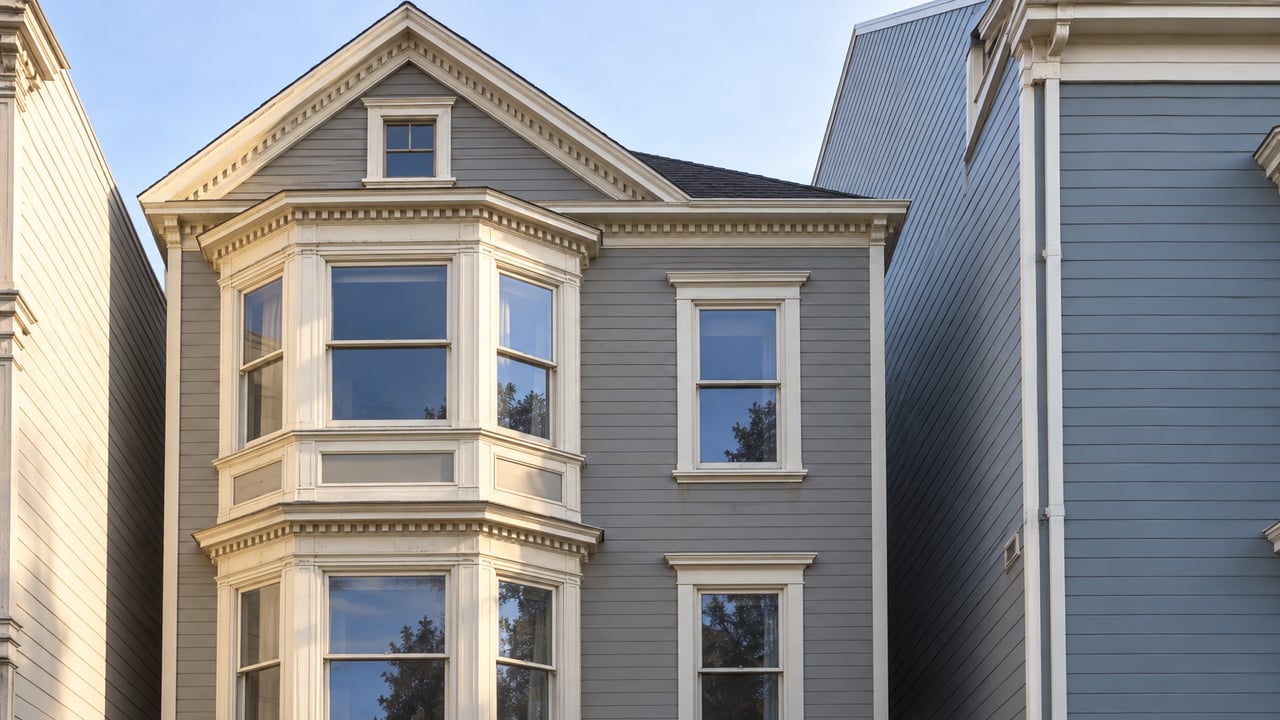
In 2020, a rebuilt house on Jersey Street with close to 3,500 square feet sold for almost $5 million. In April 2026 the same house sold again for $7.6 million, the San Francisco Standard reported. Lamisse Droubi, the agent quoted in that article, said the city's limit on "monster homes" over 3,000 square feet "has only driven up the value" of houses that were expanded or rebuilt before the rule took effect.
The mechanism behind her comment is written into the city code, and it changes how a Noe Valley house should be priced. Under current San Francisco rules, square footage well above 3,000 is mostly something a seller already has. A buyer can add only a small increment later. The Noe Valley homes above that line now form a supply that grows only at the margins, and the homes below it have a legal ceiling on how far they can grow.
The friction that shows up in escrow
Many buyers make their offer with a plan already in mind: buy the 2,000-square-foot Victorian, dig out the ground floor, add a level in back. In Noe Valley that plan now runs into Planning Code Section 249.92, the Central Neighborhoods Large Residence Special Use District. Its core sentence says that no residential development or expansion may produce a dwelling unit larger than 3,000 square feet of gross floor area, except where the total increase to an existing unit is less than 15%.
The details below are where the cap affects a purchase.
| Provision | How Section 249.92 handles it |
|---|---|
| Size ceiling | No unit may end up above 3,000 square feet of gross floor area |
| Small-addition exception | Allowed when the total increase to an existing unit is under 15% |
| Lookback | Expansions permitted in the previous 10 years count toward the increase, except permits issued before January 1, 2022 |
| Unpermitted space | Counts toward the increase no matter when it was built |
| Garage space | Floor area used for accessory parking is excluded |
| Shared areas | Common stairwells and atriums in multi-unit buildings are excluded |
Read plainly, the rule means a 2,000-square-foot house can grow to 3,000 square feet and no further. A house that is already near or above 3,000 can add less than 15%. Because of the 10-year lookback, a recent addition counts against that 15%, so an owner can't add space in small steps that each stay under the limit.
The unpermitted-space clause matters most during a transaction. In a city full of finished basements and converted garages, a room built without a permit doesn't just raise disclosure questions. Under the code it counts as part of the increase "regardless of the date of construction," which can use up some or all of the expansion room a buyer thought the house had. That makes the permit history as important as the floor plan.
How a hearing became a hard cap
The district began as a discretionary review process. Ordinance 35-22, sponsored by Supervisor Rafael Mandelman, applied to complete development applications submitted on or after January 1, 2022. Large projects needed Conditional Use authorization, and that review weighed factors such as whether a project added housing units.
The city's 2023 housing production legislation, Ordinance 248-23, changed that. It set the Conditional Use requirement to expire at the end of 2024, after which a flat 3,000-square-foot cap would apply. SF Planning's summary ties the expiration to the state law SB 423 and confirms that after December 31, 2024, the prohibition on units above 3,000 square feet remained, along with the under-15% exception.
The change took away the case-by-case hearing where an owner could argue for a larger project. The current code has no district-specific hearing route. The rule also grew. Ordinance 253-25, approved December 17, 2025, took effect January 17, 2026 according to the current code, though SF Planning's summary lists January 16. It widened the boundary, extended the controls to all lots inside it, and folded in the former Corona Heights district. The district now covers Noe Valley, the Castro, Corona Heights, and Cole Valley. The mapped boundary in the code, not neighborhood names, decides whether a given parcel is inside.
More homes allowed, bigger homes capped
The Family Zoning Plan, signed December 12, 2025, makes it look as if San Francisco has stopped limiting construction. SF Planning describes the plan as allowing taller housing along major transit and commercial corridors, removing density limits in some residential areas within existing height limits, and allowing up to five stories near selected commercial streets. The current code still includes Section 249.92, and Ordinance 253-25 is its most recent amendment.
Together, the two rules point in one direction. The city now allows more units on a Noe Valley lot while limiting how large each unit can be. Planning's Housing Choice–SF bulletin, last updated September 10, 2026, describes a project-specific path for changes to objective standards. Replacing one single-family house with another single-family house is ineligible. An alteration that adds a second unit that isn't an ADU can qualify.
Projects in the pipeline follow the same direction. In April 2026, SF YIMBY reported plans for 398 Day Street near the Church and Day Muni stop. The proposal would replace a 1938 duplex with four apartments, three with two bedrooms and one with three, in a building of about 4,550 square feet and 40 feet tall. Total floor area can still grow in Noe Valley when it is split among several homes. A single house can't grow much past 3,000 square feet.
Where the demand is landing
The supply side matters because Noe Valley houses were not built large. The Standard notes that many were built for working-class households and often top out around 2,000 square feet. In its September 2026 issue, the Noe Valley Voice described a 3,745-square-foot house as about twice the size of a typical home in the neighborhood.
Buyers came anyway. The Voice counted 34 single-family sales in June and July 2026, the most for those months since the summer of 2021, compared with 12 condominium sales. Single-family homes averaged $4,025,000 at 131% of list price in June 2026 and $3,891,000 at 125% of list in July 2026. Christine Lopatowski of Corcoran Icon, which supplies the paper's sales data, told the Voice, "It's the AI market," and said buyers want "Bedroom space. Home office space. Perhaps au pair space."
The most recent MLS figures show the same pace. In August 2026, Noe Valley recorded six single-family closings at a median of $4,930,000, an average of 128.1% of original list price, and five days on market. Citywide in the third quarter of 2026, the single-family median reached $2 million, up 23.1% from a year earlier, and 87.8% of single-family homes sold over asking.
What the named sales show
A few sales from spring and summer 2026, all reported by the Voice or the Standard, show how size and price interact.
| Property | Size | Result |
|---|---|---|
| Jersey Street rebuild, April 2026 | Nearly 3,500 sq ft | $7.6 million, up from almost $5 million in 2020 |
| 4500 block of 25th Street, June 2026 | 3,745 sq ft, five bedrooms | $6,733,500, 12.3% over its $5,995,000 asking price |
| 23rd Street updated house, June 2026 | Not reported | $3,815,805, 78% over its $2,150,000 asking price |
| 700 block of Duncan Street, July 2026 | 4,402 sq ft, five bedrooms | $6.1 million, 8.5% below its $6,665,666 asking price after nearly four months |
Four sales are not a trend line. Still, they suggest that the premium on large houses shows up in the final price more than in the size of the overbid. The highest percentage over asking went to a house listed at $2.15 million. The largest house in the group stayed on the market for months and sold below its ask. Above about 4,000 square feet, buyers in summer 2026 appear to have had a limit on what they would pay, even for space the city now lets owners add only in small increments.
Space above the line comes mainly from homes already built, plus additions of under 15% to them. Buyers who need that space are competing for a supply that can grow only in small steps. Buyers who don't need it are bidding on smaller houses whose growth potential now has a defined legal limit.
Questions buyers raise about the cap
Does the cap apply to condos and flats? The limit applies to each dwelling unit. In multi-unit buildings, shared stairwells, atriums, and other common areas are left out of the calculation.
Does a garage count toward the 3,000 square feet? Under the code's definition for this district, floor space used for accessory parking is not counted.
Are older applications covered? Applications filed before June 4, 2024 for lots that were not then in either large-residence district are exempt. That exemption matters most for lots added by the 2025 expansion.
Has state housing law overridden the cap? The sources reviewed for this article don't show that any state law categorically overrides Section 249.92. The rule is still in the city code as of October 2026. Whether a particular project qualifies for a different route is a question for land-use counsel and the Planning Department.
If you're weighing a Noe Valley house partly on what it could become, Victoria Stewart and our team can help you check its permitted square footage and permit history against the 3,000-square-foot limit before you write an offer. Request a Confidential Consultation.
This article is general information, not legal, tax or financial advice. Consult a qualified professional about your situation.